
Introduction
Cataracts — the clouding of the eye’s natural lens — are one of the most common causes of vision loss worldwide. Fortunately, modern technology has revolutionized cataract treatment. The most advanced and widely used method today is phacoemulsification, commonly called phaco surgery.
What makes phaco surgery remarkable is its use of ultrasound energy to break and remove the cataract through a tiny incision. But how exactly does this science work? In this blog, we explore the science behind phacoemulsification, how ultrasound removes cataracts, and why this technology has become the gold standard for modern cataract surgery.
Understanding Cataracts First
Before diving into the science of phacoemulsification, it’s important to understand cataracts:
- The natural lens of the eye focuses light on the retina for clear vision.
- With age or other risk factors, lens proteins clump together, forming a cloudy area that blocks light.
- This causes blurred vision, glare, difficulty reading, and faded colors.
Cataracts can develop slowly over years, and while glasses may help temporarily, surgery is the only effective solution to restore clear vision.
What Is Phacoemulsification?
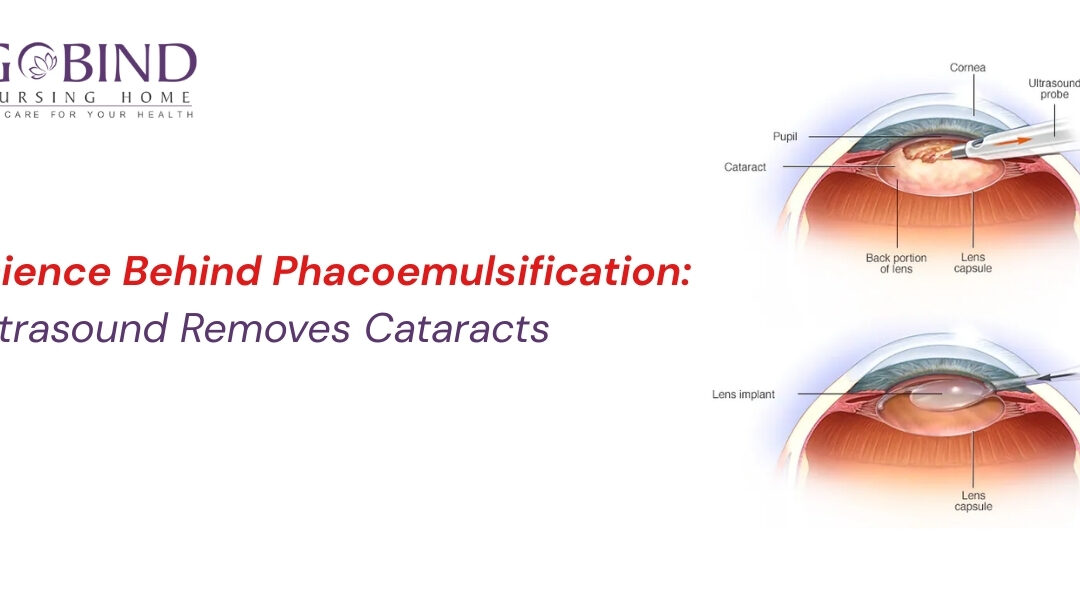
Phacoemulsification is a minimally invasive cataract surgery technique that uses ultrasound energy to fragment the cloudy lens, which is then suctioned out of the eye.
Key points:
- Tiny 2–2.8 mm incision (self-sealing, no stitches)
- Ultrasound probe emulsifies the cataract
- Foldable intraocular lens (IOL) replaces the natural lens
- Quick recovery and minimal discomfort
The term “phacoemulsification” comes from:
- Phaco = lens
- Emulsification = breaking into tiny pieces for easy removal
The Science Behind Ultrasound in Phaco
Ultrasound refers to sound waves with frequencies higher than the human ear can detect. In phacoemulsification, high-frequency ultrasound vibrations are applied to break the cataract into microscopic fragments.
Here’s how it works step by step:
1. Energy Transmission
- A phaco probe is inserted into the lens through a micro-incision.
- The probe tip vibrates at 40,000 cycles per second (40 kHz), generating ultrasonic energy.
2. Cavitation Effect
- The vibrations create microscopic bubbles in the liquid inside the eye.
- These bubbles collapse rapidly, producing tiny shockwaves that help disintegrate the hardened lens tissue.
3. Fragmentation of the Lens
- The combined effect of ultrasound energy and fluid flow breaks the cataract into extremely small pieces.
- This allows safe removal through the tiny incision, minimizing trauma to surrounding tissues.
4. Suction and Removal
- As the lens fragments are emulsified, the phaco probe simultaneously sucks them out of the eye.
- The process is continuous, efficient, and controlled, preventing damage to the delicate cornea and retina.
Why Ultrasound Works So Well
The key advantages of using ultrasound in cataract surgery are:
- Precision:- The probe targets the cataract directly while sparing surrounding tissue.
- Minimally Invasive:-Tiny fragments can be removed through a micro-incision, avoiding stitches.
- Faster Recovery:- Less trauma leads to quicker healing and reduced post-operative inflammation.
- Customizable Energy:- Modern phaco machines allow surgeons to adjust ultrasound power, pulse duration, and fluid flow based on the cataract’s density.
- Safe and Reliable:- Ultrasound energy can emulsify even hard, dense cataracts that traditional manual methods struggle with.
Step-by-Step Process of Phacoemulsification
Here’s a simplified view of how phaco surgery works scientifically:
- Anesthesia & Sterilization:-Eye drops numb the eye; the area is cleaned and sterilized.
- Micro Incision–2.8 mm incision is made at the edge of the cornea.
- Capsulorhexis:- A circular opening is made in the lens capsule.
- Ultrasound Emulsification:-The phaco probe emits high-frequency vibrations, breaking the lens into tiny fragments.Cavitation bubbles enhance fragmentation.
- Suction Removal:-Lens fragments are aspirated out through the same probe.
- IOL Implantation:-A foldable intraocular lens is inserted to restore vision.
- Self-Sealing Incision:-Tiny incision heals naturally; no stitches are required.
Modern Technology in Phaco Surgery
Recent innovations in phacoemulsification have made the procedure even safer and more efficient:
- Microincision Phaco (MICS): Incisions smaller than 2 mm
- Torsional Phaco: Side-to-side tip motion reduces energy and heat, protecting the cornea
- Femtosecond Laser-Assisted Phaco: Laser pre-treats the cataract for higher precision
- Advanced IOL Options: Monofocal, multifocal, toric, and EDOF lenses for customized vision
These technologies combine science, engineering, and ophthalmology to maximize safety, comfort, a
Advantages Over Traditional Cataract Surgery
| Feature | Traditional Cataract Surgery (ECCE) | Phacoemulsification (Ultrasound) |
| Incision Size | 10–12 mm | 2–2.8 mm |
| Stitches | Required | Not required (self-sealing) |
| Recovery Time | 4–6 weeks | 1–2 weeks |
| Precision | Manual | High, ultrasound-assisted |
| Visual Outcome | Slower | Immediate improvement |
| Trauma to Eye | Higher | Minimal |
Ultrasound phaco is less invasive, safer, and allows faster return to daily activities.
Who Should Consider Phaco Surgery
Phacoemulsification is suitable for most patients with cataracts, including those with:
- Age-related cataracts
- Diabetes-related cataracts
- Moderate to hard cataracts
- Patients seeking faster recovery and modern lens options
- Your ophthalmologist will assess your eye health and recommend the best IOL for your lifestyle.
Why Choose an Experienced Surgeon
Success in phaco surgery depends on expertise, precision, and proper machine settings. For patients in Hisar and nearby regions:
Our Cataract team at Gobind Eye Care offers:
- Advanced ultrasound phacoemulsification
- Personalized patient care
- Safe, stitch-less procedures
- High success rates and fast visual recovery
Choosing a skilled surgeon ensures optimal outcomes, minimal complications, and long-lasting vision improvement.
Post-Operative Care
After phaco surgery, proper care ensures successful healing:
- Use prescribed eye drops to prevent infection and inflammation
- Wear protective glasses for a few days
- Avoid rubbing the eye or heavy lifting for 1–2 weeks
- Attend follow-up appointments
Most patients regain clear vision within 24–48 hours, with complete recovery in 2–3 weeks.
Conclusion
The science behind phacoemulsification is a marvel of modern ophthalmology. By using ultrasound energy to precisely emulsify the cataract, surgeons can remove the cloudy lens through a tiny incision, replace it with a foldable intraocular lens, and restore clear, bright vision — often within a single day.
Phacoemulsification combines engineering, physics, and medical expertise to deliver safe, efficient, and predictable outcomes, making it the gold standard in modern cataract surgery.
For anyone struggling with cloudy vision, Our Cataract team at Gobind Eye Care, Hisar, offers expert phacoemulsification services — helping patients regain clear, vibrant vision safely and effectively.
Experience the science of clear vision with phacoemulsification — where ultrasound meets life-changing eye care.