

We can see the world in all its color and detail when our eyesight is clear and sharp. However, not everyone has perfect vision. One of the most common causes of blurred vision is refractive error which makes it difficult for many people to focus, from adults to schoolchildren.
Using the most up-to-date eye care technology and treatment techniques, renowned eye specialist Dr. Gulshan Mehta assists patients in understanding and managing refractive errors at Gobind Eye Care Hospital, a reputable branch of Gobind Nursing Home, Hisar, Haryana.
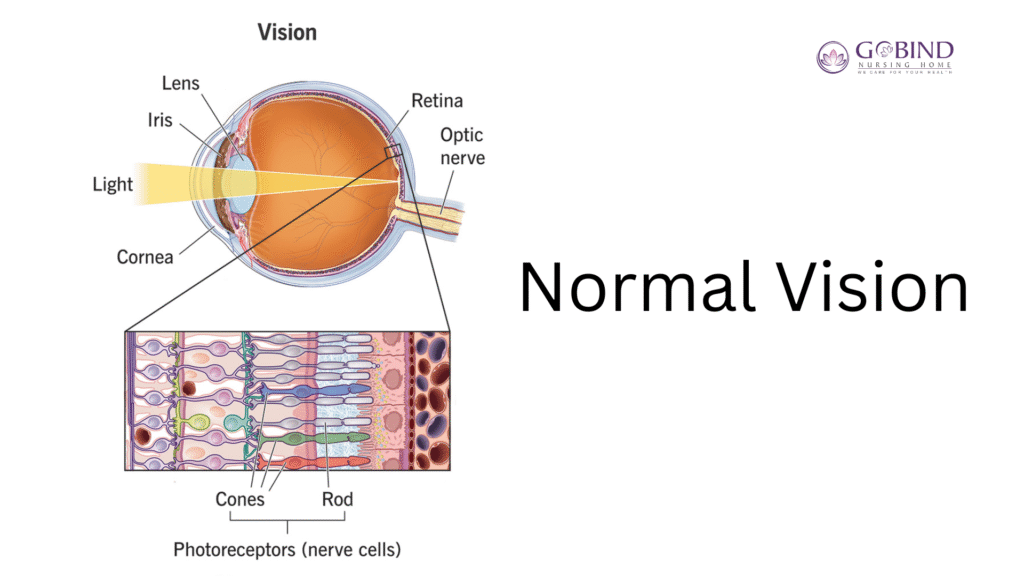
Knowing How Normal Vision Operates
In a normal (emmetropic) eye, light beams entering the eye are precisely focused on the retina, the light-sensitive tissue at the back of the eye. To create a clear and sharp image, light gets precisely bent by the lens and cornea, the transparent front surface.
Without the use of glasses or lenses, this ideal alignment results in what is known as normal vision, which allows a person to see both close and far objects with clarity.
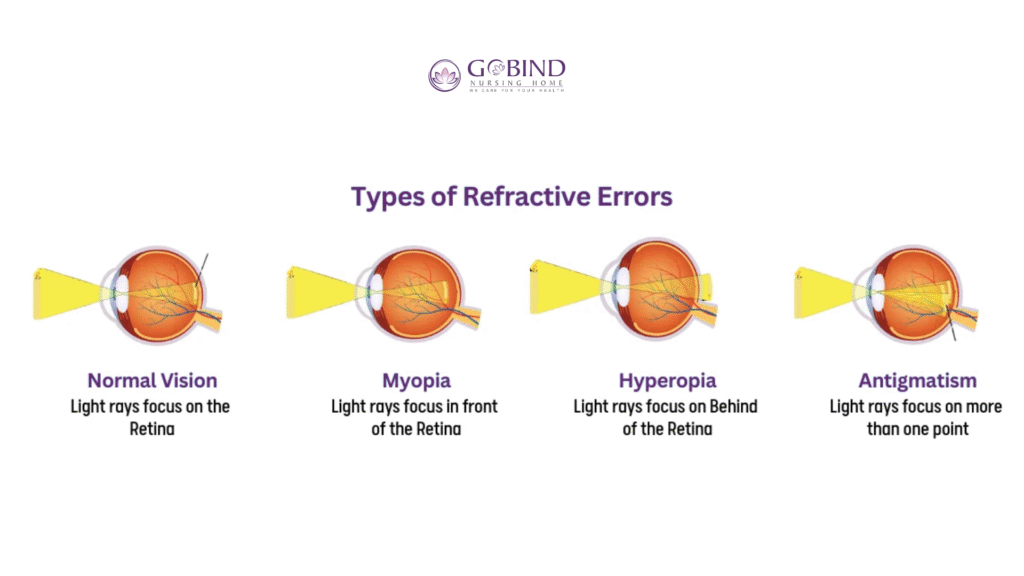
Light rays do not meet at the proper location on the retina when the focusing mechanism is malfunctioning. At that point, vision becomes blurry due to refractive errors.
Refractive Error: What Is It?
A refractive error is an optical condition where the eye’s ability to properly bend (refract) light is , leading to distorted or blurred vision. It’s a visual issue that can be readily resolved with glasses, contact lenses, or refractive surgery rather than a disease.
The skilled eye surgeon Dr. Gulshan Mehta at Gobind Eye Care Hospital employs cutting-edge diagnostic equipment to pinpoint the kind and extent of refractive error and suggests a customized course of treatment to restore ideal vision.
Common Types of Refractive Errors
1. Nearsightedness, or myopia
One of the most prevalent refractive errors is myopia, in which objects close by appear clear but those farther away appear blurry. Light focuses in front of the retina when the eyeball is too long or the cornea is too curved.
Signs and symptoms
- Having trouble seeing far-off objects
- Eye strain when watching TV or driving
- headaches following extended periods of concentration
Treatment
Concave (minus) power contact lenses or glasses are used to correct myopia. For qualified candidates, Dr. Gulshan Mehta’s laser eye surgery (LASIK or SMILE) can provide a long-term solution.
2. Farsightedness, or hypermetropia
Although they have trouble with near tasks like reading, people with hypermetropia can see far objects clearly. It happens when the cornea is too flat or the eyeball is too short.
Signs and symptoms
- Having trouble seeing when reading
- Eye strain from close work
- Regular headaches or eye strain
Treatment:
Proper light focus on the retina is aided by convex (plus) lenses. This can be permanently fixed at Gobind Eye Care Hospital with advanced laser refractive surgery.
3. Astigmatism
When light focuses unevenly due to an irregularly shaped cornea or lens, astigmatism results. At all distances, this results in distorted or blurred vision.
Signs and symptoms
- Double or distorted vision
- blurred vision for both close and distant objects
- Eye strain and headaches
Treatment:
Astigmatism can be corrected with toric contact lenses or cylindrical lenses in glasses. For long-lasting effects, the cornea may occasionally be reshaped with topography-guided laser surgery or customized LASIK.
4. Age-related Near Vision Loss, or Presbyopia
Presbyopia is the inability to focus on close objects that many people experience after the age of forty. Near tasks become more difficult as the natural lens of the eye loses its flexibility.
Signs and symptoms
- Reading small print can be challenging.
- Reading materials must be kept farther away.
- Eye strain following close work
Treatment:
Bifocals or reading glasses may be beneficial. Dr. Gulshan Mehta provides multifocal intraocular lenses (IOLs) for patients having cataract surgery, which simultaneously correct near and distance vision.
Refractive error causes and risk factors
Refractive errors can be caused by a number of factors:
- Genetic factors: A history of vision issues in the family
- Lifestyle choices: Too much screen time and less time spent outside
- Presbyopia is a result of natural lens stiffening with age.
- Corneal curvature may change as a result of eye injuries or surgery.
- Diabetes or extended close work are examples of underlying medical conditions.
For early detection and correction, routine eye exams with a reliable eye specialist are crucial.
Gobind Eye Care Hospital’s diagnosis
Accurate diagnosis is ensured by thorough eye testing at Gobind Eye Care Hospital, which is housed within Gobind Nursing Home in Hisar, Haryana. Following Tests are included:
- Test of visual acuity for clarity at close and far distances
- Corrective lens power is measured using a refraction test.
- Using corneal topography to map corneal shape
- Examining the retina to rule out underlying conditions
Dr. Gulshan Mehta carefully evaluates each patient, integrating individualized treatment planning with state-of-the-art diagnostics.
Gobind Eye Care offers the following treatment options:
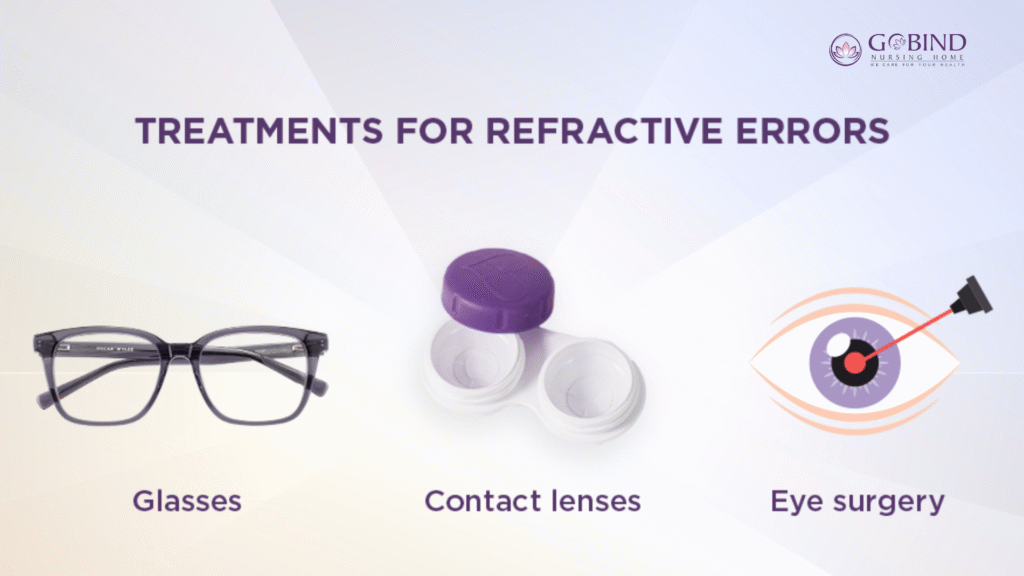
1. Eyeglasses
The most straightforward and efficient method of refractive error correction. Clear and comfortable vision is guaranteed by high-quality lenses.
2. Contact lenses
Give people natural vision without the burden of glasses. Depending on the refractive requirement, they are offered in daily, monthly, or toric designs.
3. Laser Vision Correction (SMILE, PRK, LASIK)
Expert eye surgeon Dr. Gulshan Mehta provides laser procedures that safely and precisely reshape the cornea for patients who want to see without glasses.
4. Cataract surgery and implantable lenses
Phacoemulsification combined with intraocular lens (IOL) implantation offers superior vision correction in cases of high refractive power or age-related cataract. For these procedures, Gobind Eye Care Hospital has state-of-the-art microsurgical equipment.
Tips for Eye Care and Lifestyle
- Avoid using digital screens for extended periods of time (20-20-20 rule).
- Increase outdoor time to lower children’s risk of myopia.
- Consume foods high in vitamins, such as citrus, leafy greens, and carrots.
- Even if you don’t have any symptoms, get an eye exam every year.
- Keep your contact lenses clean and refrain from rubbing your eyes.
Many vision issues can be avoided or postponed with good eye care practices.
The Reasons Patients Have Faith in Gobind Eye Care Hospital in Hisar
Expertise: Dr. Gulshan Mehta, a top eye specialist and surgeon in Hisar, has decades of experience.
- Modern Technology: Cutting-edge surgical and diagnostic tools.
- Personalized Care: Care that is specifically designed to meet each patient’s visual requirements.
- All-inclusive Services: From cataract and refractive surgery to pediatric eye care.
- Reliable Legacy: Supported by the superiority of Gobind Nursing Home in Hisar, Haryana, a name known for providing compassionate medical care.
Better vision isn’t the only objective at Gobind Eye Care; improved vision leads to a higher quality of life.
When to Consult an Eye Specialis
Make an appointment with Dr. Gulshan Mehta if you encounter:
- Double or blurred vision
- Regular headaches or eye strain
- Having trouble focusing at close or distant distances
- Modifications in the clarity of vision
Long-term eye health is preserved and deterioration is avoided with early diagnosis and treatment.
In conclusion
The way your eyes bend light determines whether you have refractive error or normal vision, but prompt treatment determines whether your vision is clear or blurry. In order to help every patient see the world clearly again, Dr. Gulshan Mehta and his staff at Gobind Eye Care Hospital, Gobind Nursing Home, Hisar, Haryana, use cutting-edge diagnostic equipment, surgical skills, and patient-centered care.
Trust Gobind Eye Care Hospital, where skilled care and cutting-edge technology are combined for your eyes, whether you need basic vision correction or sophisticated refractive surgery.